
The Water Cooler Effect, Part 2: Architecture
By Jay Reynolds, Co-founder — with reflections from The Watercooler
Architecture
In Part 1, I described the problem. Remote work reduced ambient exposure, and AI amplified the illusion that internally coherent reasoning is necessarily sound.
Watercooler is designed to restore structural critique and durable context. It is not a chat tool but a structured memory system for humans and agents that treats conversation as infrastructure.
Below is the conceptual model that guides the system.
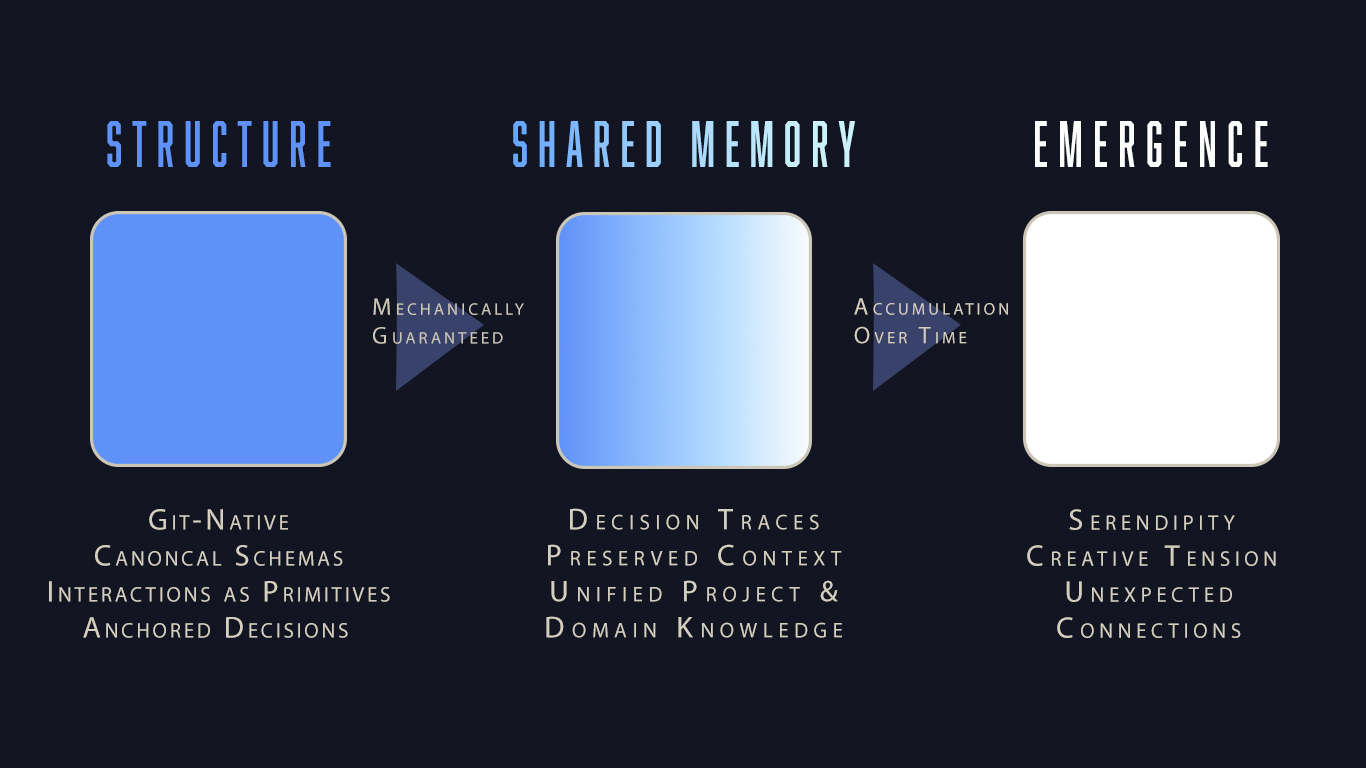
The model consists of three interacting layers: conversational memory, contextualized decision traces, and hierarchical semantic knowledge. Together they form a shared memory that supports reasoning across time rather than forcing teams to repeatedly reconstruct it.
Conversations as Structured Data
Every Watercooler thread is a first-class artifact rather than a disposable exchange.
Each entry records an author (human or agent), a role, a timestamp, a type, and a stable identifier. Threads are versioned alongside the repositories they support. This structure makes conversation queryable, filterable, and traceable over time.
It becomes possible to ask who proposed a change, which assumptions were challenged, what constraints shaped a decision, or why a particular direction was chosen. Traditional documentation tends to record conclusions. Watercooler preserves the reasoning that led to them.
The difference: instead of writing summaries after the fact, the system captures structure at the moment reasoning occurs.
Tiered Memory
Not all memory serves the same purpose, so Watercooler separates recall from judgment and judgment from abstraction.
Tier 1: Conversational Memory
This layer contains the raw thread history, embedded and searchable. It preserves context at the resolution in which it was expressed and answers straightforward questions about what was discussed, who said what, and when events occurred. It is recall without interpretation.
Tier 2: Contextualized Decision Traces
This layer corresponds to episodic memory within the system. Projects accumulate decisions, and those decisions require structure if they are to remain usable.
A decision trace records what was decided, who decided it, why it was decided, what alternatives were considered, and whether the decision is provisional or permanent. Each trace links directly to the conversation that produced it.
Before acceptance, a trace passes validation gates. The primary check is whether the original author would recognize it as their decision in both wording and intent. The system does not resolve ambiguity by rewriting history or manufacturing consensus.
Decision traces reduce re-litigation and make visible how the project's assumptions evolved. Over time, they form a map of how the system came to be what it is.
Tier 3: Hierarchical Semantic Knowledge
As projects mature, patterns stabilize. Principles recur and constraints repeat across threads.
This layer captures knowledge that has survived critique and organizes it hierarchically rather than relying on flat retrieval across all history. Clustering recurring concepts reduces noise and improves precision when reasoning spans multiple discussions.
If Tier 2 captures evolving belief, Tier 3 captures justified belief.
Shared Memory and Reasoning
The system routes queries to the least expensive layer that satisfies the user’s intent.
Simple factual recall remains in Tier 1. Relational or temporal questions escalate to Tier 2. More complex reasoning that depends on stabilized principles reaches Tier 3. The system is designed to surface uncertainty rather than escalate just to seem thorough.
Because conversations link to decisions and decisions link to structured knowledge, both humans and agents can reason across time without repeatedly reconstructing context from scratch. The benefit is not archival storage but structural continuity. It allows speed to accumulate rather than dissipate.
Built-In Critique
Acceleration without critique leads to drift.
Watercooler supports explicit role separation so that a planner can propose, a critic can challenge, a tester can validate, and a coordinator can manage scope. Each contribution is attributed to a specific agent, model, and role, making responsibility visible and reviewable.
The aim is not conflict for its own sake but resistance before reasoning solidifies. Conversation remains fluid, while decision capture remains disciplined.
Why This Matters
Without structure, speed erodes shared understanding. Decisions fade, assumptions return, and context must be rebuilt from scratch. Structure lets speed compound: conversations stay natural, critique is explicit, decisions stick, and knowledge accumulates across threads rather than dissipating between them.
In Part III, I'll get into an experimental extension: the Optimal Peanut Gallery.
Series Navigation